Module 4: Population Growth Trend, 1901-2011
Concept
Subtopic 4.1: Census-wise Population Table
- Bihar's population was 2.73 crore in 1901 and 3.87 crore in 1951; it grew to 8.29 crore in 2001 and 10.40 crore in 2011.
- The 1991 figure (8,63,38,853) is for undivided Bihar; the 2001 figure (8,29,98,509) is after bifurcation, so it looks lower.
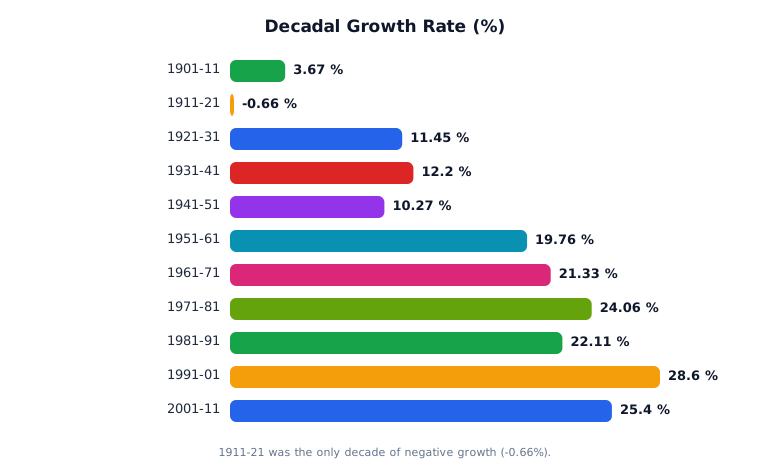
- The highest decadal growth was +28.6% in 1991-2001, with the highest annual rate 2.84%. The only negative decade was 1911-21 (−0.66%).
| Census year | Population | Decadal growth (%) | Annual growth (%) |
|---|---|---|---|
| 1901 | 2,73,11,865 | — | — |
| 1911 | 2,83,14,281 | +3.67 | 0.36 |
| 1921 | 2,81,26,675 | -0.66 | 0.06 |
| 1931 | 3,13,47,108 | +11.45 | 1.14 |
| 1941 | 3,51,70,840 | +12.2 | 1.22 |
| 1951 | 3,87,82,271 | +10.27 | 1.02 |
| 1961 | 4,64,77,457 | +19.76 | 1.97 |
| 1971 | 5,63,53,369 | +21.33 | 2.13 |
| 1981 | 6,99,14,734 | +24.06 | 2.04 |
| 1991 | 8,63,38,853 | +22.11 | 2.34 |
| 2001 (bifurcation) | 8,29,98,509 | +28.6 | 2.84 |
| 2011 | 10,40,99,452 | +25.4 | — |

- 2,73,11,865 ≈ 2.73 crore.
- 3,87,82,271 ≈ 3.87 crore.
- 1911-21: −0.66%.
- 28.6% in 1991-2001 (annual 2.84%).
- The 2001 figure covers only the new Bihar after November 2000.
- 1961 census: +19.76% (annual 1.97%).
- 1991-2001 annual growth 2.84%.
- Question: What was Bihar's population in 1901? Answer: 2.73 crore.
- Question: Bihar's population in 1951 was about: Answer: 3.87 crore.
- Question: Which census decade recorded negative growth in Bihar? Answer: 1911-21.
- Question: Highest decadal growth in the table was recorded in: Answer: 1991-2001 (28.6%).
- Question: Why is Bihar's 2001 population (8.29 crore) lower than 1991 (8.63 crore)? Answer: Bifurcation (Jharkhand separated).
- Question: Decadal growth of Bihar during 1951-61 was: Answer: 19.76%.
- Question: Which decade had the highest annual growth rate (2.84%)? Answer: 1991-2001.
MCQs
Answer this question, then use Next.
Question 1: What was Bihar's population in 1901?
Question 2: Bihar's population in 1951 was about:
Question 3: Which census decade recorded negative growth in Bihar?
Question 4: Highest decadal growth in the table was recorded in:
Question 5: Why is Bihar's 2001 population (8.29 crore) lower than 1991 (8.63 crore)?
Question 6: Decadal growth of Bihar during 1951-61 was:
Question 7: Which decade had the highest annual growth rate (2.84%)?
One-liners
Write your answer, then submit to see the correct answer.
What was Bihar's population in 1901?
2.73 crore.Bihar's population in 1951 was about:
3.87 crore.Which census decade recorded negative growth in Bihar?
1911-21.Highest decadal growth in the table was recorded in:
1991-2001 (28.6%).Why is Bihar's 2001 population (8.29 crore) lower than 1991 (8.63 crore)?
Bifurcation (Jharkhand separated).Decadal growth of Bihar during 1951-61 was:
19.76%.Which decade had the highest annual growth rate (2.84%)?
1991-2001.Concept
Subtopic 4.2: Phases of Growth and Their Causes
- 1901-1921: slow growth because of high birth and high death rates. Lack of health facilities, epidemics like cholera, plague and influenza, and floods and droughts kept deaths high.
- 1911-1921: population growth was negative.
- 1921-1951: growth was irregular and moderate; until 1951 lack of adequate economic development held back growth.
- 1951-2011: rapid growth, mainly due to a fall in the death rate while the birth rate did not fall much.
- High births were offset by high deaths.
- Cholera, plague and influenza.
- Irregular and moderate.
- Falling deaths with steady births.
- Inadequate economic development.
- Question: Why was population growth slow in Bihar from 1901 to 1921? Answer: High birth rate and high death rate.
- Question: Which epidemics are named as causes of high deaths in 1901-1921? Answer: Cholera, plague, influenza.
- Question: Population growth in Bihar between 1921 and 1951 was: Answer: Irregular and moderate.
- Question: What is the main reason for rapid growth from 1951 to 2011? Answer: Fall in death rate, birth rate not falling much.
- Question: why did successive growth decline until 1951? Answer: Lack of adequate economic development.
MCQs
Answer this question, then use Next.
Question 1: Why was population growth slow in Bihar from 1901 to 1921?
Question 2: Which epidemics are named as causes of high deaths in 1901-1921?
Question 3: Population growth in Bihar between 1921 and 1951 was:
Question 4: What is the main reason for rapid growth from 1951 to 2011?
Question 5: why did successive growth decline until 1951?
One-liners
Write your answer, then submit to see the correct answer.
Why was population growth slow in Bihar from 1901 to 1921?
High birth rate and high death rate.Which epidemics are named as causes of high deaths in 1901-1921?
Cholera, plague, influenza.Population growth in Bihar between 1921 and 1951 was:
Irregular and moderate.What is the main reason for rapid growth from 1951 to 2011?
Fall in death rate, birth rate not falling much.why did successive growth decline until 1951?
Lack of adequate economic development.Concept
Subtopic 4.3: Birth Rate and Death Rate
- Bihar's birth rate is 27.7 per thousand and its death rate is 6.7 per thousand.
- So the natural growth is about 21 per thousand (27.7 − 6.7).
- Answer (b) 27.7.
- Death rate 6.7 per thousand.
- 27.7 − 6.7 = 21.0 per thousand.
- Question: What is the birth rate (per thousand) in Bihar as per 2011? [BPSC PYQ] Answer: 27.7.
- Question: What is Bihar's death rate (per thousand)? Answer: 6.7.
- Question: Using these figures, Bihar's natural growth rate is about: Answer: 21 per thousand.
MCQs
Answer this question, then use Next.
Question 1: What is the birth rate (per thousand) in Bihar as per 2011? [BPSC PYQ]
Question 2: What is Bihar's death rate (per thousand)?
Question 3: Using these figures, Bihar's natural growth rate is about:
One-liners
Write your answer, then submit to see the correct answer.
What is the birth rate (per thousand) in Bihar as per 2011? [BPSC PYQ]
27.7.What is Bihar's death rate (per thousand)?
6.7.Using these figures, Bihar's natural growth rate is about:
21 per thousand.