Module 9: Child Population and Child Sex Ratio
Concept
Subtopic 9.1: Child Sex Ratio (0-6 years)
- Bihar's child sex ratio is 935 (2011) — praiseworthy compared with the national average of 919.
- Still, it has declined from 942 in 2001.
- Highest child sex ratio: Kishanganj 971; lowest: Vaishali 904.
- Answer (d) 935.
- India 919; Bihar 935.
- 942 in 2001, declining to 935.
- Kishanganj 971.
- Vaishali 904.
- Question: What is the sex ratio of children aged 0-6 years in the state? [Objective set] Answer: 935.
- Question: India's child sex ratio in 2011 was: Answer: 919.
- Question: Bihar's child sex ratio in 2001 was: Answer: 942.
- Question: Which district has the highest child sex ratio (971)? Answer: Kishanganj.
- Question: The lowest child sex ratio (904) is in: Answer: Vaishali.
MCQs
Answer this question, then use Next.
Question 1: What is the sex ratio of children aged 0-6 years in the state? [Objective set]
Question 2: India's child sex ratio in 2011 was:
Question 3: Bihar's child sex ratio in 2001 was:
Question 4: Which district has the highest child sex ratio (971)?
Question 5: The lowest child sex ratio (904) is in:
One-liners
Write your answer, then submit to see the correct answer.
What is the sex ratio of children aged 0-6 years in the state? [Objective set]
935.India's child sex ratio in 2011 was:
919.Bihar's child sex ratio in 2001 was:
942.Which district has the highest child sex ratio (971)?
Kishanganj.The lowest child sex ratio (904) is in:
Vaishali.Concept
Subtopic 9.2: Share of Children (0-6) in the Population
- Child population (0-6) in 2011: 1,91,33,964 (boys 98,87,239; girls 92,46,725).
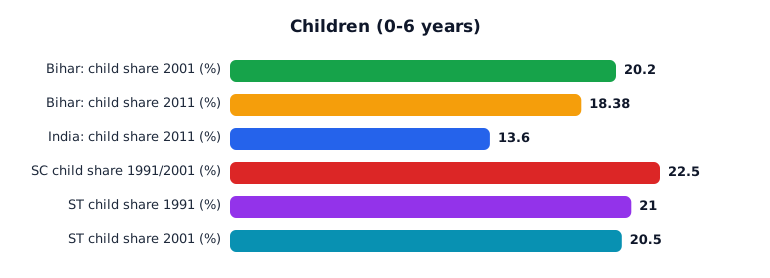
- Its share fell from 20.2% (2001) to 18.38% (2011; profile rounds to 18.4%). India's share is 13.6% (16,44,78,150 children).
- SC child share was 22.5% in both 1991 and 2001; ST child share was 21.0% in 1991 and 20.5% in 2001.
- As printed, the largest child population is in Kishanganj (10,18,297) and the smallest in Munger (1,21,647). Note: Kishanganj's whole population is only 16.9 lakh, so this figure looks doubtful.
- Answer (b) 1,91,33,964.
- Answer (d): Araria 30.25% > Khagaria 30.19%; three districts (Sheikhpura, Sheohar, Arwal) are below 10 lakh; CSR 935 is correct.
- 18.38% (20.2% in 2001).
- India 13.6%.
- 22.5% in both censuses.
- 2001: 20.5%; 1991: 21.0%.
- Girls 92,46,725; boys 98,87,239.
- Munger.
- Kishanganj (10,18,297) as printed; the figure looks doubtful because the district's total population is 16.9 lakh.
- Question: What is the total population of children aged 0-6 in the state? [Objective set] Answer: 1,91,33,964.
- Question: Consider: 1. Araria's growth rate is lower than Khagaria's. 2. Only 2 districts of Bihar have a population below 10 lakh. 3. Sex ratio of the 0-6 age group in Bihar is 935. Which is/are correct? [Objective set] Answer: Only 3.
- Question: Share of children (0-6) in Bihar's population in 2011 was: Answer: 18.38%.
- Question: What share of India's population was aged 0-6 in 2011? Answer: 13.6%.
- Question: SC child population share in Bihar in both 1991 and 2001 was: Answer: 22.5%.
- Question: ST child population share in 2001 was ____ against ____ in 1991. Answer: 20.5%, 21.0%.
- Question: Number of girls (0-6) in Bihar in 2011: Answer: 92,46,725.
- Question: which district has the smallest child population (1,21,647)? Answer: Munger.
- Question: As printed, which district has the largest child population? Answer: Kishanganj.
MCQs
Answer this question, then use Next.
Question 1: What is the total population of children aged 0-6 in the state? [Objective set]
Question 2: Consider: 1. Araria's growth rate is lower than Khagaria's. 2. Only 2 districts of Bihar have a population below 10 lakh. 3. Sex ratio of the 0-6 age group in Bihar is 935. Which is/are correct? [Objective set]
Question 3: Share of children (0-6) in Bihar's population in 2011 was:
Question 4: What share of India's population was aged 0-6 in 2011?
Question 5: SC child population share in Bihar in both 1991 and 2001 was:
Question 6: ST child population share in 2001 was ____ against ____ in 1991.
Question 7: Number of girls (0-6) in Bihar in 2011:
Question 8: which district has the smallest child population (1,21,647)?
Question 9: As printed, which district has the largest child population?
One-liners
Write your answer, then submit to see the correct answer.
What is the total population of children aged 0-6 in the state? [Objective set]
1,91,33,964.Consider: 1. Araria's growth rate is lower than Khagaria's. 2. Only 2 districts of Bihar have a population below 10 lakh. 3. Sex ratio of the 0-6 age group in Bihar is 935. Which is/are correct? [Objective set]
Only 3.Share of children (0-6) in Bihar's population in 2011 was:
18.38%.What share of India's population was aged 0-6 in 2011?
13.6%.SC child population share in Bihar in both 1991 and 2001 was:
22.5%.ST child population share in 2001 was ____ against ____ in 1991.
20.5%, 21.0%.Number of girls (0-6) in Bihar in 2011:
92,46,725.which district has the smallest child population (1,21,647)?
Munger.As printed, which district has the largest child population?
Kishanganj.