Module 2: Nature of Agriculture & the Shri Vidhi Method
Concept
Subtopic 2.1: Agriculture in Bihar at a Glance
- Current position (Bihar Economic Survey 2025-26): net sown area 54.12 lakh ha, gross cropped area 82.07 lakh ha, cropping intensity 1.52. Foodgrains occupy 95.2% of cultivated land (cereals 89.2%, pulses 6.0%).
- Bihar is an agricultural state: more than 80% of its land is cultivable and the net sown area exceeds 57%.
- About 86% of the population is engaged in agriculture.
- Agriculture is most dominant in the northern plains of the Ganga, where 65% to 80% of the land is farmed.
- Rice is the staple food, so paddy is grown in every district; by production, wheat is the second crop after rice.
- 1.52 (gross cropped 82.07 lakh ha / net sown 54.12 lakh ha).
- 95.2% (cereals alone 89.2%).
- Cultivable land in Bihar is more than 80%, of which the net sown area is more than 57%.
- The net sown area is more than 57%.
- 86% of the state's population is engaged in agriculture.
- Agriculture is most dominant in the northern Ganga plains, where 65-80% of the land is farmed.
- Wheat is the second crop after rice; paddy is grown in all districts.
- Question: What is Bihar's cropping intensity as per the Economic Survey 2025-26? Answer: 1.52.
- Question: What share of Bihar's cultivated land is under foodgrains (2020-21 to 2024-25)? Answer: 95.2%.
- Question: What share of Bihar's land is cultivable? Answer: More than 80%.
- Question: What is the net sown area of Bihar? Answer: More than 57%.
- Question: What percentage of Bihar's population is engaged in agriculture? Answer: 86%.
- Question: In the northern plains of the Ganga, what share of the land is under agriculture? Answer: 65% to 80%.
- Question: By production, which is the second crop of Bihar after rice? Answer: Wheat.
MCQs
Answer this question, then use Next.
Question 1: What is Bihar's cropping intensity as per the Economic Survey 2025-26?
Question 2: What share of Bihar's cultivated land is under foodgrains (2020-21 to 2024-25)?
Question 3: What share of Bihar's land is cultivable?
Question 4: What is the net sown area of Bihar?
Question 5: What percentage of Bihar's population is engaged in agriculture?
Question 6: In the northern plains of the Ganga, what share of the land is under agriculture?
Question 7: By production, which is the second crop of Bihar after rice?
One-liners
Write your answer, then submit to see the correct answer.
What is Bihar's cropping intensity as per the Economic Survey 2025-26?
1.52.What share of Bihar's cultivated land is under foodgrains (2020-21 to 2024-25)?
95.2%.What share of Bihar's land is cultivable?
More than 80%.What is the net sown area of Bihar?
More than 57%.What percentage of Bihar's population is engaged in agriculture?
86%.In the northern plains of the Ganga, what share of the land is under agriculture?
65% to 80%.By production, which is the second crop of Bihar after rice?
Wheat.Concept
Subtopic 2.2: Shri Vidhi (SRI) and the Rise in Foodgrain Output
- Current position (Bihar Economic Survey 2025-26): in 2024-25 Bihar produced 247.83 lakh tonnes of foodgrains: cereals 243.91 lakh t (rice 99.34, wheat 78.27, maize 66.03) and pulses about 3.92 lakh t. The 2010-12 figures are given below.
- Shares in cereal output (2024-25): rice 40.7%, wheat 32.1%, maize 27.1%; together 99.9%. Maize has the highest yield (6,913 kg/ha), against wheat 3,344 and rice 2,970 kg/ha.
- According to the Bihar Economic Survey 2012-13, foodgrain production in 2011-12 was 68 lakh tonnes more than in the previous year.
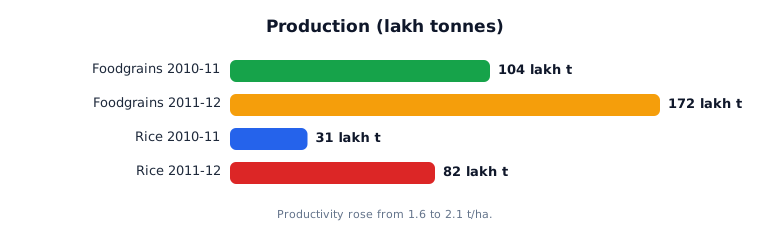
- In 2010-11 the state produced 104 lakh tonnes of foodgrains; in 2011-12 it produced 172 lakh tonnes.
- Rice production rose from 31 lakh tonnes (2010-11) to 82 lakh tonnes within a year. The rise is credited to the Shri Vidhi technique of paddy cultivation.
- Farmers using Shri Vidhi got an average of about 8 t/ha; hybrid varieties gave 5 t/ha and ordinary fields 4 t/ha.
- State productivity rose from 1.6 t/ha to 2.1 t/ha. The record came not by increasing area but by raising productivity through Shri Vidhi.

- 247.83 lakh tonnes (Economic Survey 2025-26).
- Maize, 6,913 kg/ha.
- 99.34 lakh tonnes.
- The increase is attributed to the use of the Shri Vidhi technique in paddy cultivation.
- 172 lakh tonnes in 2011-12, compared with 104 lakh tonnes in 2010-11.
- As per the Bihar Economic Survey 2012-13 it was 68 lakh tonnes more.
- Rice production rose from 31 to 82 lakh tonnes within a year.
- Shri Vidhi gave about 8 t/ha, against 5 t/ha for hybrids and 4 t/ha for ordinary fields.
- Productivity rose from 1.6 to 2.1 t/ha, by raising productivity rather than area.
- Question: Bihar's foodgrain production in 2024-25 was about: Answer: 248 lakh t.
- Question: Which cereal has the highest yield per hectare in Bihar (2024-25)? Answer: Maize.
- Question: Bihar's rice production in 2024-25 was about: Answer: 99 lakh t.
- Question: Which technique is credited with the sharp rise in Bihar's paddy and foodgrain output in 2011-12? Answer: Shri Vidhi.
- Question: How much foodgrain did Bihar produce in 2011-12? Answer: 172 lakh tonnes.
- Question: By how much did foodgrain production in 2011-12 exceed the previous year? Answer: 68 lakh tonnes.
- Question: Rice production in Bihar rose from 31 lakh tonnes in 2010-11 to how much in one year? Answer: 82 lakh tonnes.
- Question: What average yield did farmers get using Shri Vidhi? Answer: About 8 t/ha.
- Question: State productivity rose from 1.6 t/ha to how much? Answer: 2.1 t/ha.
MCQs
Answer this question, then use Next.
Question 1: Bihar's foodgrain production in 2024-25 was about:
Question 2: Which cereal has the highest yield per hectare in Bihar (2024-25)?
Question 3: Bihar's rice production in 2024-25 was about:
Question 4: Which technique is credited with the sharp rise in Bihar's paddy and foodgrain output in 2011-12?
Question 5: How much foodgrain did Bihar produce in 2011-12?
Question 6: By how much did foodgrain production in 2011-12 exceed the previous year?
Question 7: Rice production in Bihar rose from 31 lakh tonnes in 2010-11 to how much in one year?
Question 8: What average yield did farmers get using Shri Vidhi?
Question 9: State productivity rose from 1.6 t/ha to how much?
One-liners
Write your answer, then submit to see the correct answer.
Bihar's foodgrain production in 2024-25 was about:
248 lakh t.Which cereal has the highest yield per hectare in Bihar (2024-25)?
Maize.Bihar's rice production in 2024-25 was about:
99 lakh t.Which technique is credited with the sharp rise in Bihar's paddy and foodgrain output in 2011-12?
Shri Vidhi.How much foodgrain did Bihar produce in 2011-12?
172 lakh tonnes.By how much did foodgrain production in 2011-12 exceed the previous year?
68 lakh tonnes.Rice production in Bihar rose from 31 lakh tonnes in 2010-11 to how much in one year?
82 lakh tonnes.What average yield did farmers get using Shri Vidhi?
About 8 t/ha.State productivity rose from 1.6 t/ha to how much?
2.1 t/ha.