Module 2: Fisheries in Bihar
Concept
Subtopic 2.1: Fishery Resources
- Fish are caught from the Ganga and its tributaries, and reared in small rivers, tanks, lakes and ponds.
- Reservoirs, tals, talaiyas, maun and chaur cover about 1.38 lakh hectares, but only 10% of tanks and ponds are scientifically managed.
- Bihar has 29 medium and small reservoirs, yet only 27,000 hectares of water area has been developed for fish farming.
- They cover about 1.38 lakh hectares.
- Only 10% are scientifically managed.
- Only 27,000 ha has been developed despite 29 reservoirs and vast water resources.
- Bihar has 29 medium and small reservoirs.
- Question: About how much area do Bihar's water bodies for fisheries cover? Answer: 1.38 lakh ha.
- Question: What share of tanks and ponds in Bihar is scientifically managed? Answer: Only 10%.
- Question: How much water area has actually been developed for fish farming? Answer: 27,000 ha.
- Question: How many medium and small reservoirs does Bihar have? Answer: 29.
MCQs
Answer this question, then use Next.
Question 1: About how much area do Bihar's water bodies for fisheries cover?
Question 2: What share of tanks and ponds in Bihar is scientifically managed?
Question 3: How much water area has actually been developed for fish farming?
Question 4: How many medium and small reservoirs does Bihar have?
One-liners
Write your answer, then submit to see the correct answer.
About how much area do Bihar's water bodies for fisheries cover?
1.38 lakh ha.What share of tanks and ponds in Bihar is scientifically managed?
Only 10%.How much water area has actually been developed for fish farming?
27,000 ha.How many medium and small reservoirs does Bihar have?
29.Concept
Subtopic 2.2: Fish Species and Production
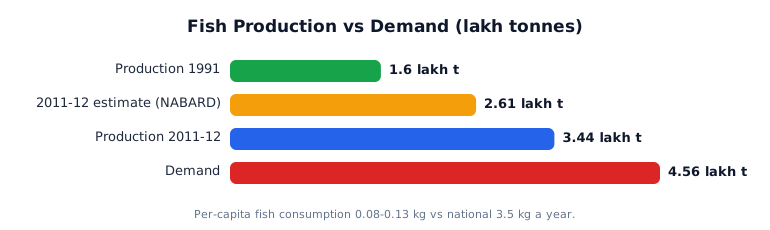
- Current position (Bihar Economic Survey 2025-26): fish production reached 9.6 lakh t in 2024-25 (+9.9%); Bihar has risen to 4th in India (from 9th a decade ago). Madhubani is the leading fish-producing district; per-capita availability is about 9.5 kg/year. The 1991-2012 figures are given below.
- The main fish are Rohu, Katla, Bhakur and Mangur. Boari, Tengra, Saurathi, Banspatta, prawn, Bachwa, perch, loach, Payas, silver carp, Kabai, Singhi and Garai are also popular.
- Fish production was 1.60 lakh tonnes in 1991. NABARD estimated 2.61 lakh t for 2011-12, while demand is about 4.56 lakh t.
- Actual production in 2011-12 was 3.44 lakh tonnes.
- Per-capita consumption is 0.08-0.13 kg a year, far below the national average of 3.5 kg.
- Bihar imports fish worth about ₹250 crore a year, mainly from Andhra Pradesh.
- About 9.6 lakh tonnes.
- Madhubani.
- 4th, up from 9th a decade ago.
- Rohu, Katla, Bhakur and Mangur are the main fish of Bihar.
- Production was 3.44 lakh t (NABARD's estimate was 2.61 lakh t; demand 4.56 lakh t).
- Demand is about 4.56 lakh tonnes.
- Bihar's 0.08-0.13 kg is far below the national average of 3.5 kg.
- Fish worth about ₹250 crore a year comes from Andhra Pradesh.
- Production was 1.60 lakh metric tonnes in 1991.
- Question: Bihar's fish production in 2024-25 was about: Answer: 9.6 lakh t.
- Question: Which is Bihar's leading fish-producing district (Economic Survey 2025-26)? Answer: Madhubani.
- Question: Bihar's rank in India in fish production (2024-25): Answer: 4th.
- Question: Which are the main fish of Bihar? Answer: Rohu, Katla, Bhakur, Mangur.
- Question: What was Bihar's fish production in 2011-12? Answer: 3.44 lakh t.
- Question: What is the estimated fish demand in Bihar? Answer: 4.56 lakh t.
- Question: Bihar's per-capita annual fish consumption is compared with what national average? Answer: 3.5 kg.
- Question: From which state does Bihar import fish worth about ₹250 crore a year? Answer: Andhra Pradesh.
- Question: What was Bihar's fish production in 1991? Answer: 1.60 lakh t.
MCQs
Answer this question, then use Next.
Question 1: Bihar's fish production in 2024-25 was about:
Question 2: Which is Bihar's leading fish-producing district (Economic Survey 2025-26)?
Question 3: Bihar's rank in India in fish production (2024-25):
Question 4: Which are the main fish of Bihar?
Question 5: What was Bihar's fish production in 2011-12?
Question 6: What is the estimated fish demand in Bihar?
Question 7: Bihar's per-capita annual fish consumption is compared with what national average?
Question 8: From which state does Bihar import fish worth about ₹250 crore a year?
Question 9: What was Bihar's fish production in 1991?
One-liners
Write your answer, then submit to see the correct answer.
Bihar's fish production in 2024-25 was about:
9.6 lakh t.Which is Bihar's leading fish-producing district (Economic Survey 2025-26)?
Madhubani.Bihar's rank in India in fish production (2024-25):
4th.Which are the main fish of Bihar?
Rohu, Katla, Bhakur, Mangur.What was Bihar's fish production in 2011-12?
3.44 lakh t.What is the estimated fish demand in Bihar?
4.56 lakh t.Bihar's per-capita annual fish consumption is compared with what national average?
3.5 kg.From which state does Bihar import fish worth about ₹250 crore a year?
Andhra Pradesh.What was Bihar's fish production in 1991?
1.60 lakh t.Concept
Subtopic 2.3: Fish Seed (Jeera) and the Government's Role
- The state has encouraged fish-egg production and fish farming since 1975. In 2008-09, 393 lakh fingerlings were produced at a cost of ₹161.60 lakh and distributed to farmers.
- In 2011-12 a record 3604.58 lakh fish seed (jeera) were produced and distributed; Darbhanga tops with 90 million jeera.
- Fish farming has been given the status of agriculture, so it can use all facilities available to farming.
- 1010 farmers were trained in fish farming at Kakinada, Andhra Pradesh.
- On 3 May 2006 the Bihar Fish Jalkar Management Act was enforced with a clear policy for leasing government ponds and reservoirs; settlement of government water bodies comes under the Bihar Water Bodies Management Act-2006.
- Leases are of two kinds: 5 years (short) for co-operative societies, and 10 years (long) for trained persons, fishermen or fishermen self-help groups. A new insurance scheme for fish farmers began in 2011-12.

- Darbhanga tops with 90 million jeera.
- A record 3604.58 lakh fish seed were produced and distributed.
- 1010 farmers were trained at Kakinada, Andhra Pradesh.
- It was enforced on 3 May 2006.
- Co-operatives get a short 5-year lease; trained fishermen and SHGs get 10 years.
- 393 lakh fingerlings were produced in 2008-09.
- Fish farming has the status of agriculture, so it can use all farm facilities.
- Question: Which district tops Bihar in fish-seed (jeera) production? Answer: Darbhanga.
- Question: How much fish seed was produced and distributed in Bihar in 2011-12? Answer: 3604.58 lakh.
- Question: Where were 1010 Bihar farmers trained in fish farming? Answer: Kakinada, Andhra Pradesh.
- Question: When was the Bihar Fish Jalkar Management Act enforced? Answer: 3 May 2006.
- Question: Under the 2006 Act, for how long can water bodies be leased to fishermen co-operative societies? Answer: 5 years.
- Question: In 2008-09, how many fingerlings were produced and distributed at a cost of ₹161.60 lakh? Answer: 393 lakh.
- Question: What status has fish farming been given in Bihar? Answer: Agriculture.
MCQs
Answer this question, then use Next.
Question 1: Which district tops Bihar in fish-seed (jeera) production?
Question 2: How much fish seed was produced and distributed in Bihar in 2011-12?
Question 3: Where were 1010 Bihar farmers trained in fish farming?
Question 4: When was the Bihar Fish Jalkar Management Act enforced?
Question 5: Under the 2006 Act, for how long can water bodies be leased to fishermen co-operative societies?
Question 6: In 2008-09, how many fingerlings were produced and distributed at a cost of ₹161.60 lakh?
Question 7: What status has fish farming been given in Bihar?
One-liners
Write your answer, then submit to see the correct answer.
Which district tops Bihar in fish-seed (jeera) production?
Darbhanga.How much fish seed was produced and distributed in Bihar in 2011-12?
3604.58 lakh.Where were 1010 Bihar farmers trained in fish farming?
Kakinada, Andhra Pradesh.When was the Bihar Fish Jalkar Management Act enforced?
3 May 2006.Under the 2006 Act, for how long can water bodies be leased to fishermen co-operative societies?
5 years.In 2008-09, how many fingerlings were produced and distributed at a cost of ₹161.60 lakh?
393 lakh.What status has fish farming been given in Bihar?
Agriculture.Concept
Subtopic 2.4: Fishermen Co-operatives and Potential
- Bihar has 590 fishermen co-operatives, of which only 243 are currently functional.
- There are about 28,780 jalkars or tanks and 43,000 tanks and reservoirs, mostly under the state fisheries department, plus 29 small and medium artificial lakes.
- According to the Director-General of the ICAR, fish production in Bihar can be raised 30 to 35 times.
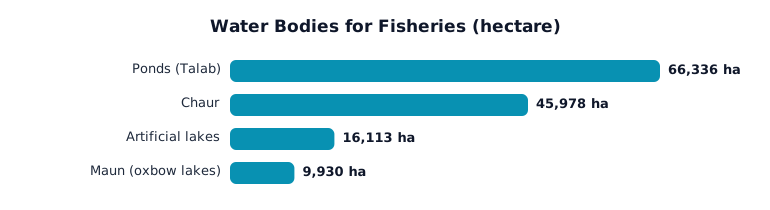
- Water resources for fisheries: ponds 66,336 ha, maun (oxbow lakes) 9,930 ha, chaur 45,978 ha and artificial lakes 16,113 ha.
- The Ganga, Kosi, Son, Bagmati, Gandak and Punpun are sources of capture fisheries.
| Water resource | Area (ha) |
|---|---|
| Ponds (Talab) | 66,336 |
| Maun (oxbow lakes) | 9,930 |
| Chaur | 45,978 |
| Artificial lakes | 16,113 |
- There are 590 co-operatives, of which only 243 are functional.
- Production can be raised 30 to 35 times.
- Ponds cover 66,336 ha, followed by chaur 45,978, artificial lakes 16,113 and maun 9,930 ha.
- Maun means oxbow lake; maun cover 9,930 ha.
- There are about 28,780 jalkars/tanks and 43,000 tanks & reservoirs.
- Question: How many fishermen co-operatives does Bihar have, and how many are functional? Answer: 590; 243 functional.
- Question: By how many times can Bihar's fish production be increased, according to ICAR's Director-General? Answer: 30-35 times.
- Question: Which type of water body covers the largest area for fisheries in Bihar? Answer: Ponds (talab).
- Question: 'Maun' in Bihar's fisheries context refers to what? Answer: Oxbow lake.
- Question: How many jalkars or tanks does Bihar have? Answer: 28,780.
MCQs
Answer this question, then use Next.
Question 1: How many fishermen co-operatives does Bihar have, and how many are functional?
Question 2: By how many times can Bihar's fish production be increased, according to ICAR's Director-General?
Question 3: Which type of water body covers the largest area for fisheries in Bihar?
Question 4: 'Maun' in Bihar's fisheries context refers to what?
Question 5: How many jalkars or tanks does Bihar have?
One-liners
Write your answer, then submit to see the correct answer.
How many fishermen co-operatives does Bihar have, and how many are functional?
590; 243 functional.By how many times can Bihar's fish production be increased, according to ICAR's Director-General?
30-35 times.Which type of water body covers the largest area for fisheries in Bihar?
Ponds (talab).'Maun' in Bihar's fisheries context refers to what?
Oxbow lake.How many jalkars or tanks does Bihar have?
28,780.