Module 2: Water Management and Irrigation
Concept
Subtopic 2.1: Need for Irrigation, Floods and Droughts
- 96% of Bihar's net irrigated area is irrigated (as printed).
- Irrigation is needed most where average rainfall is below 1200 mm. North Bihar's perennial rivers always provide water, but the South Bihar plain, with rivers dry most of the year, needs more irrigation.
- 28 districts of Bihar are flood-affected, mainly in the North Ganga plain.
- Parts of 3-4 districts such as Aurangabad, Gaya and Nawada suffer drought every year or two.
- 28 districts are flood-affected, mainly in the North Ganga plain.
- Irrigation is needed most where rainfall is below 1200 mm.
- Parts of Aurangabad, Gaya and Nawada suffer drought every year or two.
- South Bihar's rivers carry less water and are almost dry most of the year.
- Question: How many districts of Bihar are flood-affected? Answer: 28.
- Question: Irrigation is needed most in parts of Bihar with average annual rainfall below what? Answer: 1200 mm.
- Question: Which districts are given as examples of occasional drought? Answer: Aurangabad, Gaya, Nawada.
- Question: Why does the South Bihar plain need more irrigation than North Bihar? Answer: Its rivers carry less water and stay nearly dry most of the year.
MCQs
Answer this question, then use Next.
Question 1: How many districts of Bihar are flood-affected?
Question 2: Irrigation is needed most in parts of Bihar with average annual rainfall below what?
Question 3: Which districts are given as examples of occasional drought?
Question 4: Why does the South Bihar plain need more irrigation than North Bihar?
One-liners
Write your answer, then submit to see the correct answer.
How many districts of Bihar are flood-affected?
28.Irrigation is needed most in parts of Bihar with average annual rainfall below what?
1200 mm.Which districts are given as examples of occasional drought?
Aurangabad, Gaya, Nawada.Why does the South Bihar plain need more irrigation than North Bihar?
Its rivers carry less water and stay nearly dry most of the year.Concept
Subtopic 2.2: Irrigation Potential and Share of Sources
- As per 'India-2013', Bihar's total irrigation potential is 35.36 lakh ha: 28.73 lakh ha from major and medium projects and 6.63 lakh ha from minor irrigation.
- Irrigation is done by canals, tanks, tube-wells and wells; canals and tube-wells are the most important, while wells and tanks irrigate only small areas.
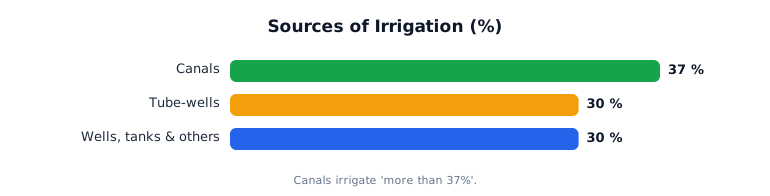
- Canals are the main source, irrigating more than 37% of irrigated land; tube-wells about 30%; wells, tanks and others together about 30%.
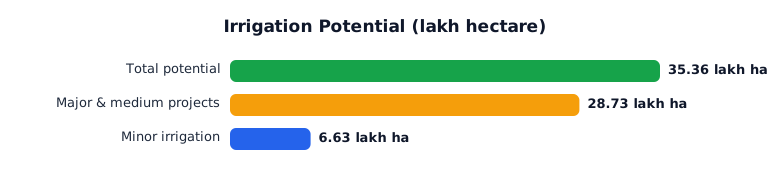
- Total potential is 35.36 lakh ha (28.73 major & medium + 6.63 minor).
- Minor irrigation can irrigate 6.63 lakh hectares.
- Canals irrigate more than 37% of irrigated land.
- Tube-wells irrigate about 30%; wells, tanks and others together another 30%.
- Question: What is Bihar's total irrigation potential according to 'India-2013'? Answer: 35.36 lakh ha.
- Question: How much irrigation potential comes from minor irrigation schemes? Answer: 6.63 lakh ha.
- Question: Which is the main source of irrigation in Bihar? Answer: Canals.
- Question: About what share of irrigated land do tube-wells irrigate? Answer: 30%.
MCQs
Answer this question, then use Next.
Question 1: What is Bihar's total irrigation potential according to 'India-2013'?
Question 2: How much irrigation potential comes from minor irrigation schemes?
Question 3: Which is the main source of irrigation in Bihar?
Question 4: About what share of irrigated land do tube-wells irrigate?
One-liners
Write your answer, then submit to see the correct answer.
What is Bihar's total irrigation potential according to 'India-2013'?
35.36 lakh ha.How much irrigation potential comes from minor irrigation schemes?
6.63 lakh ha.Which is the main source of irrigation in Bihar?
Canals.About what share of irrigated land do tube-wells irrigate?
30%.Concept
Subtopic 2.3: Sources of Irrigation and Leading Districts
- Canals are used especially in areas of perennial rivers with gentle slopes; where rivers are seasonal, rain-fed (barsati) canals are built.
- The well is the second source; with the spread of electricity, its importance has grown sharply.
- Leading districts — canal: Bhojpur (73.8%), Aurangabad (71.1%), W. Champaran (68.2%); tube-well: Samastipur (97.6%), Sitamarhi (84.8%), Begusarai (80.7%).
- Well: Darbhanga (48.0%), Madhubani (37.1%), W. Champaran (23.5%), Begusarai (19.4%); tank: Madhubani (24.6%), Vaishali (21.4%), Darbhanga (6.0%).
- Electric pumps were first used in 1945-46 in the Dehri-Sasaram area, and in 1946 in the Biharsharif and Bihta areas.
- Other sources include tanks, pyne, ahar and chaur.

- Samastipur 97.6%, Sitamarhi 84.8%, Begusarai 80.7%.
- Bhojpur 73.8%, Aurangabad 71.1%, W. Champaran 68.2%.
- Electric pumps were first used in 1945-46 at Dehri-Sasaram, then in 1946 at Biharsharif and Bihta.
- Darbhanga 48.0%, Madhubani 37.1%.
- Madhubani 24.6%, Vaishali 21.4%, Darbhanga 6.0%.
- With the spread of electricity, the well (second source) has become far more important.
- Question: Which district has the highest share of tube-well irrigation (97.6%)? Answer: Samastipur.
- Question: Which district leads in canal irrigation share (73.8%)? Answer: Bhojpur.
- Question: Where were electric pumps first used for irrigation in Bihar, and when? Answer: 1945-46, Dehri-Sasaram.
- Question: Which district leads in well irrigation share (48.0%)? Answer: Darbhanga.
- Question: Which district leads in tank irrigation share (24.6%)? Answer: Madhubani.
- Question: Why has the importance of wells risen sharply in Bihar? Answer: Spread of electric power.
MCQs
Answer this question, then use Next.
Question 1: Which district has the highest share of tube-well irrigation (97.6%)?
Question 2: Which district leads in canal irrigation share (73.8%)?
Question 3: Where were electric pumps first used for irrigation in Bihar, and when?
Question 4: Which district leads in well irrigation share (48.0%)?
Question 5: Which district leads in tank irrigation share (24.6%)?
Question 6: Why has the importance of wells risen sharply in Bihar?
One-liners
Write your answer, then submit to see the correct answer.
Which district has the highest share of tube-well irrigation (97.6%)?
Samastipur.Which district leads in canal irrigation share (73.8%)?
Bhojpur.Where were electric pumps first used for irrigation in Bihar, and when?
1945-46, Dehri-Sasaram.Which district leads in well irrigation share (48.0%)?
Darbhanga.Which district leads in tank irrigation share (24.6%)?
Madhubani.Why has the importance of wells risen sharply in Bihar?
Spread of electric power.