Module 3: Canals of Bihar
Concept
Subtopic 3.1: Types of Canals and Their Coverage
- North Bihar's relief, soft alluvium, vast farmland and perennial rivers favour canal development.
- There are two types: perennial (nityavahi/sadavahi) canals, full of water all year and fed by perennial rivers or dam reservoirs (most North Bihar canals); and non-perennial canals, seasonal, taken straight from rivers and flowing with surplus flood water in the rains.
- Perennial canals are more useful: water is available whenever irrigation is needed, and they also help transport.
- Of land irrigated by canals, 73% is in the southern plain and about 24% in the northern plain.
- Canals irrigate 38.6% of total farmland.
- Over 81% of canal-irrigated land lies in Bhojpur, Buxar, Rohtas, Kaimur, W. Champaran, Patna, Aurangabad, Jehanabad, Gaya, Munger, Darbhanga, Saharsa and Madhepura.
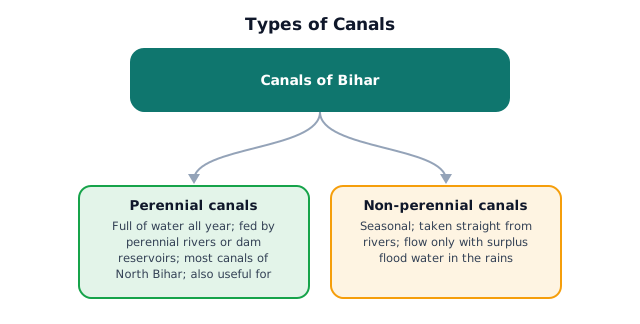
- Perennial canals are full all year, fed by perennial rivers or dam reservoirs.
- 73% is in the southern plain and about 24% in the northern plain.
- Canals irrigate 38.6% of total farmland.
- Their water is available whenever irrigation is needed, and they are useful for transport.
- Over 81% of canal-irrigated land lies in those 13 districts.
- Question: Which canals stay full of water throughout the year? Answer: Perennial (nityavahi) canals.
- Question: What share of canal-irrigated land lies in the southern plain of Bihar? Answer: 73%.
- Question: What share of Bihar's total farmland do canals irrigate? Answer: 38.6%.
- Question: Why are perennial canals more useful than non-perennial canals? Answer: Water is available whenever needed and they help transport.
- Question: Over what share of canal-irrigated land lies in districts like Bhojpur, Rohtas, Gaya and Saharsa? Answer: 81%.
MCQs
Answer this question, then use Next.
Question 1: Which canals stay full of water throughout the year?
Question 2: What share of canal-irrigated land lies in the southern plain of Bihar?
Question 3: What share of Bihar's total farmland do canals irrigate?
Question 4: Why are perennial canals more useful than non-perennial canals?
Question 5: Over what share of canal-irrigated land lies in districts like Bhojpur, Rohtas, Gaya and Saharsa?
One-liners
Write your answer, then submit to see the correct answer.
Which canals stay full of water throughout the year?
Perennial (nityavahi) canals.What share of canal-irrigated land lies in the southern plain of Bihar?
73%.What share of Bihar's total farmland do canals irrigate?
38.6%.Why are perennial canals more useful than non-perennial canals?
Water is available whenever needed and they help transport.Over what share of canal-irrigated land lies in districts like Bhojpur, Rohtas, Gaya and Saharsa?
81%.Concept
Subtopic 3.2: Major Canals and Reservoirs
- Son canals: East Son (Patna, Gaya, Bhojpur, Aurangabad) and West Son (Bhojpur, Rohtas, Buxar).
- Gandak canals: Triveni (East & West Champaran), Tirhut (Saran, Champaran) and Teur (Champaran).
- Kosi canals: East Kosi (Purnia, Araria, Saharsa, Madhepura, Supaul, Khagaria) and West Kosi (Begusarai, Darbhanga, Madhubani). Kamla canal: Darbhanga, Madhubani.
- Sakri canal: Munger, Lakhisarai, Gaya and Patna.
- The Badua reservoir was built in 1765 on the Badua river and the Chandan reservoir in 1972 on the Chandan river; both are in Bhagalpur district.
| Canal | River | Benefited districts |
|---|---|---|
| East Son canal | Son | Patna, Gaya, Bhojpur, Aurangabad |
| West Son canal | Son | Bhojpur, Rohtas, Buxar |
| Triveni canal | Gandak | East & West Champaran |
| Kamla canal | Kamla | Darbhanga, Madhubani |
| East Kosi canal | Kosi | Purnia, Araria, Saharsa, Madhepura, Supaul, Khagaria |
| West Kosi canal | Kosi | Begusarai, Darbhanga, Madhubani |
| Tirhut canal | Gandak | Saran, Champaran |
| Teur canal | Gandak | Champaran |
| Sakri canal | Sakri | Munger, Lakhisarai, Gaya, Patna |
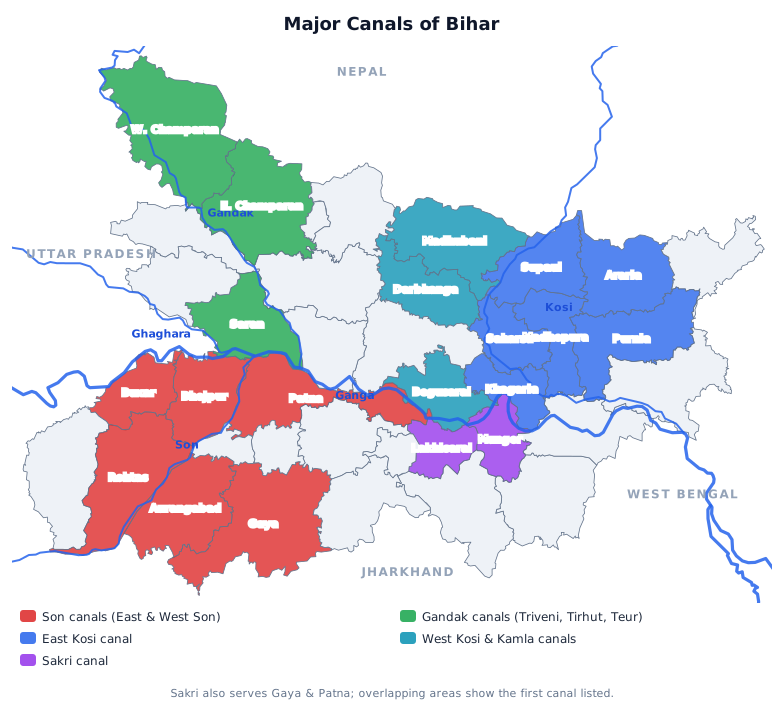
- Triveni, Tirhut and Teur canals come from the Gandak.
- West Son: Bhojpur, Rohtas, Buxar; East Son: Patna, Gaya, Bhojpur, Aurangabad.
- The Badua reservoir dates from 1765 (Chandan reservoir: 1972); both in Bhagalpur.
- The Chandan reservoir on the Chandan river was built in 1972.
- The Sakri canal serves Munger, Lakhisarai, Gaya and Patna.
- The Kamla canal serves Darbhanga and Madhubani.
- Question: The Triveni canal is drawn from which river? Answer: Gandak.
- Question: Which districts benefit from the West Son canal? Answer: Bhojpur, Rohtas, Buxar.
- Question: When was the Badua reservoir established? Answer: 1765.
- Question: When was the Chandan reservoir established? Answer: 1972.
- Question: The Sakri canal benefits which districts? Answer: Munger, Lakhisarai, Gaya, Patna.
- Question: The Kamla canal benefits which districts? Answer: Darbhanga, Madhubani.
MCQs
Answer this question, then use Next.
Question 1: The Triveni canal is drawn from which river?
Question 2: Which districts benefit from the West Son canal?
Question 3: When was the Badua reservoir established?
Question 4: When was the Chandan reservoir established?
Question 5: The Sakri canal benefits which districts?
Question 6: The Kamla canal benefits which districts?
One-liners
Write your answer, then submit to see the correct answer.
The Triveni canal is drawn from which river?
Gandak.Which districts benefit from the West Son canal?
Bhojpur, Rohtas, Buxar.When was the Badua reservoir established?
1765.When was the Chandan reservoir established?
1972.The Sakri canal benefits which districts?
Munger, Lakhisarai, Gaya, Patna.The Kamla canal benefits which districts?
Darbhanga, Madhubani.