Module 5: Ghiyasuddin Tughlaq's Invasion & End of the Karnata Dynasty
Concept
Subtopic 5.1: The Fall of Simraongarh (1324 CE) & Extinction of Dynasty (1378 CE)
The tragic collapse of the Karnata Dynasty and the advent of direct Sultanate rule over northern Bihar:
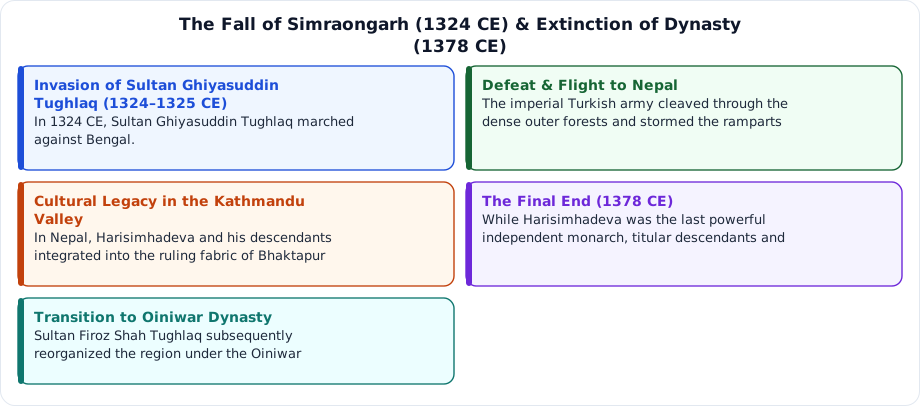
- Invasion of Sultan Ghiyasuddin Tughlaq (1324–1325 CE): In 1324 CE, Sultan Ghiyasuddin Tughlaq marched against Bengal. While returning through Tirhut, he launched an assault against Simraongarh to crush King Harisimhadeva.
- Defeat & Flight to Nepal: The imperial Turkish army cleaved through the dense outer forests and stormed the ramparts of Simraongarh. King Harisimhadeva was defeated and forced to flee northwards into the hills of Nepal along with his family and royal court.
- Cultural Legacy in the Kathmandu Valley: In Nepal, Harisimhadeva and his descendants integrated into the ruling fabric of Bhaktapur and Kathmandu, introducing Mithila's art, literature, and the worship of Goddess Taleju Bhawani.
- The Final End (1378 CE): While Harisimhadeva was the last powerful independent monarch, titular descendants and surviving scions maintained pockets of resistance until the dynasty came to a complete and definitive end by 1378 CE.
- Transition to Oiniwar Dynasty: Sultan Firoz Shah Tughlaq subsequently reorganized the region under the Oiniwar (Vainwar) Dynasty, placing Pt. Kameshwar Thakur on the throne, which fostered the golden age of Maithili literature under Mahakavi Vidyapati.
- Harisimhadeva was the last ruler of the Karnata Dynasty.
- The Karnata Dynasty came to a complete and definitive end by 1378 CE.
- Ghiyasuddin Tughlaq defeated Harisimhadeva in 1324 CE, forcing him to flee to Nepal.
- Following the Karnatas, Firoz Shah Tughlaq established the Oiniwar Dynasty in Tirhut.
- Question: Who was the last independent ruler of the Karnata Dynasty? Answer: Harisimhadeva (Hari Singh).
- Question: By which year did the Karnata Dynasty completely end? Answer: By 1378 CE.
- Question: Which Delhi Sultan defeated Harisimhadeva in 1324 CE? Answer: Ghiyasuddin Tughlaq.
MCQs
Answer this question, then use Next.
Question 1: Who was the final ruler of the Karnata Dynasty of Mithila?
Question 2: The Karnata Dynasty of Mithila came to a complete end by which year?
Question 3: Which Sultan of Delhi defeated King Harisimhadeva of the Karnata Dynasty in 1324 CE?
Question 4: Where did King Harisimhadeva flee after his capital Simraongarh was stormed by the Tughlaq army?
Question 5: Which patron deity of the Karnatas was established by Harisimhadeva's lineage in the Kathmandu valley?
Question 6: Which dynasty was installed in Mithila by Sultan Firoz Shah Tughlaq after the fall of the Karnatas?
Question 7: The famous Maithili poet Vidyapati flourished under the patronage of which Oiniwar ruler?
Question 8: In what year did Ghiyasuddin Tughlaq invade Tirhut while returning from Bengal?
Question 9: What name was assigned to Tirhut after it was incorporated into the Sultanate by Muhammad bin Tughlaq?
Question 10: In Bihar's cultural historiography, the Karnata Dynasty's era is renowned as the:
One-liners
Write your answer, then submit to see the correct answer.
Who was the last independent ruler of the Karnata Dynasty?
Harisimhadeva (Hari Singh).By which year did the Karnata Dynasty completely end?
By 1378 CE.Which Delhi Sultan defeated Harisimhadeva in 1324 CE?
Ghiyasuddin Tughlaq.