Module 4: Firoz Shah Tughlaq, Governor Malik Bayyu & Bihar Sharif
Concept
Subtopic 4.1: Capital Bihar Sharif, Malik Bayyu's Architecture & Grants to Rajgir Jain Temples
During the reign of Sultan Firoz Shah Tughlaq (1351–1388 CE), Bihar experienced extensive administrative consolidation and architectural construction:
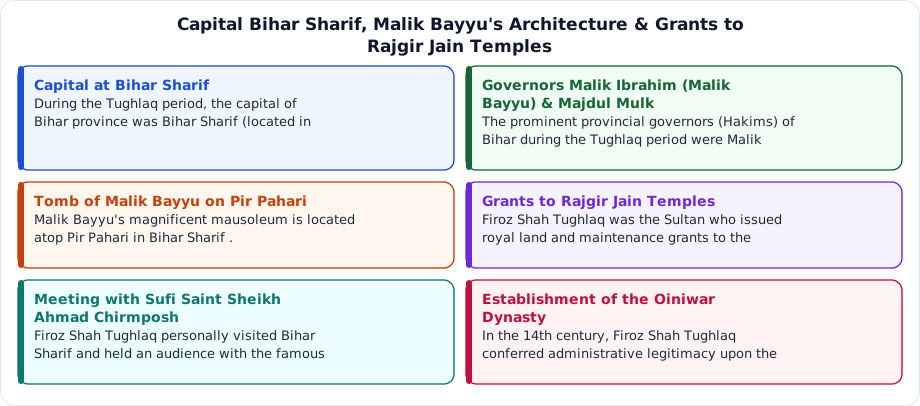
- Capital at Bihar Sharif: During the Tughlaq period, the capital of Bihar province was Bihar Sharif (located in modern Nalanda district).
- Governors Malik Ibrahim (Malik Bayyu) & Majdul Mulk: The prominent provincial governors (Hakims) of Bihar during the Tughlaq period were Malik Ibrahim (popularly known as Malik Bayyu) and Majdul Mulk. Malik Bayyu defeated local chieftains (such as Raja Bithal) and consolidated imperial authority in Magadha.
- Tomb of Malik Bayyu on Pir Pahari:
• Malik Bayyu's magnificent mausoleum is located atop Pir Pahari in Bihar Sharif.
• Architectural Specifics: Built in the 14th century, the tomb possesses two distinct structural peculiarities: sloping/battered walls (सलामी दीवारें) and a conical/elongated dome (लम्बूतरा गुंबद), reflecting early Tughlaq military architecture. - Grants to Rajgir Jain Temples: Firoz Shah Tughlaq was the Sultan who issued royal land and maintenance grants to the ancient Jain temples of Rajgir. Sanskrit and Persian records at Vipulachala hill confirm these imperial endowments.
- Meeting with Sufi Saint Sheikh Ahmad Chirmposh: Firoz Shah Tughlaq personally visited Bihar Sharif and held an audience with the famous saint Sheikh Ahmad Chirmposh (cousin of Makhdum Sharafuddin Maneri). Persian inscriptions of Firoz Tughlaq have been recovered from Bihar Sharif, Gaya, and Patna.
- Establishment of the Oiniwar Dynasty: In the 14th century, Firoz Shah Tughlaq conferred administrative legitimacy upon the Oiniwar (Vainwar) Dynasty of Tirhut. Under the benevolent shade of Oiniwar King Shiva Singh, celebrated poet Vidyapati composed his immortal Maithili verses.
- During the Tughlaq period, the capital of Bihar was Bihar Sharif.
- Malik Ibrahim (Malik Bayyu) and Majdul Mulk were prominent Tughlaq governors of Bihar.
- Malik Bayyu's tomb is situated on Pir Pahari in Bihar Sharif, featuring battered walls and a conical dome.
- Firoz Shah Tughlaq granted endowments to the Jain temples of Rajgir.
- Firoz Tughlaq met Sufi saint Sheikh Ahmad Chirmposh in Bihar.
- Firoz Shah Tughlaq installed the Oiniwar (Vainwar) dynasty in Tirhut, under whose ruler Shiva Singh poet Vidyapati composed poetry.
- Question: What was the capital of Bihar during the Tughlaq period? Answer: Bihar Sharif.
- Question: Where is the tomb of Tughlaq governor Malik Bayyu located? Answer: Bihar Sharif (Pir Pahari).
- Question: What are the architectural peculiarities of Malik Bayyu's tomb? Answer: Battered walls and a conical dome.
- Question: Which Sultan gave grants to the Jain temples of Rajgir? Answer: Firoz Shah Tughlaq.
- Question: Under which Oiniwar king's patronage did poet Vidyapati compose his verses? Answer: King Shiva Singh.
MCQs
Answer this question, then use Next.
Question 1: What was the capital of Bihar during the Tughlaq period?
Question 2: Which Sultan granted endowments to the Jain temples situated at Rajgir?
Question 3: Who occupied the post of provincial governor (Prantapati) of Bihar during the Tughlaq era?
Question 4: What is the architectural peculiarity of Malik Bayyu's tomb located in Bihar Sharif?
Question 5: Where is the tomb of Malik Ibrahim (Malik Bayyu), the most important administrator of Bihar during the Tughlaq era, located?
Question 6: Which Sultan visited and held an audience with the famous saint of Bihar, Sheikh Ahmad Chirmposh?
Question 7: Persian inscriptions of Sultan Firoz Shah Tughlaq have been recovered from which place in Bihar?
Question 8: In the 14th century, which dynasty's rule did Firoz Shah Tughlaq inaugurate in Tirhut?
Question 9: Under the patronizing canopy of which Vainwar ruler of Tirhut did celebrated poet Vidyapati compose his poetry?
Question 10: Malik Ibrahim (Malik Bayyu) was the governor of Bihar during the reign of which Sultanate dynasty?
One-liners
Write your answer, then submit to see the correct answer.
What was the capital of Bihar during the Tughlaq period?
Bihar Sharif.Where is the tomb of Tughlaq governor Malik Bayyu located?
Bihar Sharif (Pir Pahari).What are the architectural peculiarities of Malik Bayyu's tomb?
Battered walls and a conical dome.Which Sultan gave grants to the Jain temples of Rajgir?
Firoz Shah Tughlaq.Under which Oiniwar king's patronage did poet Vidyapati compose his verses?
King Shiva Singh.