Module 1: Prelude, The Patna Conflagration & Pir Ali's Martyrdom
Concept
Subtopic 1.1: Preemptive Repression and the July 3 Urban Revolt in Patna
The resistance against British rule in Bihar had deep roots dating back to the anti-British conspiracies of 1845–46 in and around Patna noted by Commissioner William Tayler. In 1857, Tayler placed key Wahhabi leaders under house arrest. The armed urban struggle erupted on 3 July 1857 under Pir Ali, a bookseller. British Opium Agent Dr. R. Lyell was killed during the clash. Pir Ali was captured and hanged on 7 July 1857. Martial regulations followed across Patna, Saran, Tirhut, and Champaran.
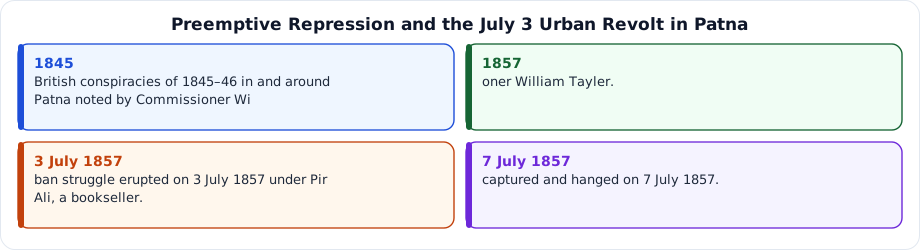
- Commissioner William Tayler arrested Wahhabi leaders Ahmadullah, Waiz-ul-Haq, and Mohammad Hussain in June 1857.
- The mass urban revolt in Patna began on 3 July 1857 under bookseller Pir Ali.
- Dr. R. Lyell was killed by Patna insurgents on 3 July 1857.
- Pir Ali was publicly executed by hanging on 7 July 1857.
- Military rule was imposed in Saran, Champaran, Tirhut, and Patna.
- Question: When did the Patna uprising begin under Pir Ali? Answer: 3 July 1857.
- Question: When was Pir Ali executed? Answer: 7 July 1857.
- Question: Which British official was killed in the Patna uprising? Answer: Dr. R. Lyell.
MCQs
Answer this question, then use Next.
Question 1: Which Wahhabi leaders were arrested by Patna Commissioner William Tayler during the 1857 struggle? I. Maulvi Ahmadullah II. Waiz-ul-Haq III. Mohammad Hussain
Question 2: To suppress the 1857 uprising, the British imposed military rule in several districts of Bihar. These districts were: I. Saran II. Tirhut III. Champaran IV. Patna
Question 7: The revolt of 1857 affected several towns of Bihar. Which option presents the correct sequence of the outbreak of rebellion in these towns?
Question 10: Under whose leadership did the mass uprising of 1857 first occur in Bihar?
Question 11: The revolt of 1857 in Bihar started on:
Question 12: Where did the 1857 revolt in Bihar first break out extensively?
Question 13: Pir Ali, leader of the 1857 revolt in Patna, was executed on:
Question 22: Who was the Commissioner of Patna at the outbreak of the revolt of 1857 in Bihar?
Question 23: When did the widespread revolt of 1857 begin in Patna?
Question 25: During the 1857 revolt in Bihar, soldiers were withdrawn from certain districts. The correct sequence of those districts is:
Question 30: Who was the leader of the 1857 uprising in Patna?
Question 43: In which year prior to 1857 was Kunwar Singh suspected of being involved in an anti-British conspiracy?
Question 70: Police Jamadar Hasan Ali Khan was hanged in 1857 in which region?
Question 72: During the formation of the police force in Patna during the 1857 revolt, which caste/community did the British refuse to enlist?
Question 73: Who was killed during the 1857 revolt in Patna?
One-liners
Write your answer, then submit to see the correct answer.
When did the Patna uprising begin under Pir Ali?
3 July 1857.When was Pir Ali executed?
7 July 1857.Which British official was killed in the Patna uprising?
Dr. R. Lyell.