Module 1: Preparation and Beginning (1930)
Concept
Subtopic 1.1: Preparation and Beginning (1930)
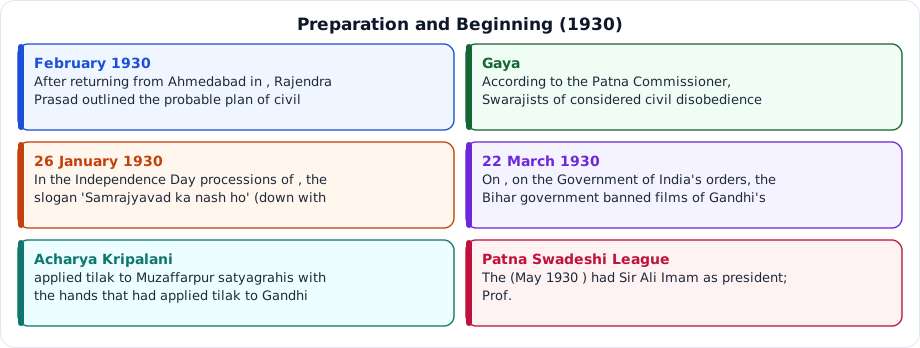
- After returning from Ahmedabad in February 1930, Rajendra Prasad outlined the probable plan of civil disobedience at Patna. A subdivisional Congress committee was formed at Mohania on 17 February 1930.
- According to the Patna Commissioner, Swarajists of Gaya considered civil disobedience over the additional police tax. At Biharsharif, Saryug Prasad tried to open a Yuvak Sangh branch with Nalanda College students.
- In the Independence Day processions of 26 January 1930, the slogan 'Samrajyavad ka nash ho' (down with imperialism) was not treated as a breach of licence conditions.
- On 22 March 1930, on the Government of India's orders, the Bihar government banned films of Gandhi's march from Ahmedabad.
- Acharya Kripalani applied tilak to Muzaffarpur satyagrahis with the hands that had applied tilak to Gandhi before the Dandi march. A hartal was observed in Patna on 6 May 1930.
- The Patna Swadeshi League (May 1930) had Sir Ali Imam as president; Prof. Abdul Bari led an organisation of Muslims in Patna to popularise the idea of freedom among them. In Sasaram the Arya Samaj took part under its local president Bhawani Dayal Sanyasi.
- Who outlined the probable plan of civil disobedience at Patna on returning from Ahmedabad in February 1930? Rajendra Prasad.
- Where was a subdivisional Congress committee formed on 17 February 1930? At Mohania.
- According to the Patna Commissioner's report, Swarajists of which place considered civil disobedience over the additional police tax? Gaya.
- 'Samrajyavad ka nash ho' (down with imperialism).
- On 22 March 1930 the Bihar government, on the Government of India's orders, banned which film of Gandhi's march from Ahmedabad? All of these.
- Who tried to open a branch of the Yuvak Sangh at Biharsharif with the help of Nalanda College students? Saryug Prasad.
- Who applied tilak to the satyagrahis of Muzaffarpur saying he had applied tilak to Gandhi with the same hands before the Dandi march? Acharya Kripalani.
- When was a hartal observed in Patna during the Civil Disobedience Movement? On 6 May 1930.
- Who was the president of the Patna Swadeshi League founded in 1930? Sir Ali Imam.
- When was the Patna Swadeshi League founded? In May 1930.
- Prof. Abdul Bari; its aim was to popularise the idea of freedom among Muslims.
- Under which local president did the Arya Samaj of Sasaram take part in civil disobedience in 1930? Bhawani Dayal Sanyasi.
- In 1929; it discussed social evils among women and the freedom of the country.
- Question: Who outlined the probable plan of civil disobedience at Patna on returning from Ahmedabad in February 1930? Answer: Rajendra Prasad.
- Question: Where was a subdivisional Congress committee formed on 17 February 1930? Answer: Mohania.
- Question: According to the Patna Commissioner's report, Swarajists of which place considered civil disobedience over the additional police tax? Answer: Gaya.
- Question: In the Independence Day processions of 26 January 1930 in Bihar, which slogan was NOT treated as a breach of licence conditions? Answer: Samrajyavad ka nash ho.
- Question: On 22 March 1930 the Bihar government, on the Government of India's orders, banned which film of Gandhi's march from Ahmedabad? Answer: All of these.
- Question: Who tried to open a branch of the Yuvak Sangh at Biharsharif with the help of Nalanda College students? Answer: Saryug Prasad.
- Question: Who applied tilak to the satyagrahis of Muzaffarpur saying he had applied tilak to Gandhi with the same hands before the Dandi march? Answer: Acharya Kripalani.
- Question: When was a hartal observed in Patna during the Civil Disobedience Movement? Answer: 6 May 1930.
- Question: Who was the president of the Patna Swadeshi League founded in 1930? Answer: Sir Ali Imam.
- Question: When was the Patna Swadeshi League founded? Answer: 1930.
- Question: Under whose presidency did Muslims set up an organisation in Patna during the Civil Disobedience Movement? Answer: Prof. Abdul Bari.
- Question: Under which local president did the Arya Samaj of Sasaram take part in civil disobedience in 1930? Answer: Bhawani Dayal Sanyasi.
- Question: When was a session of the All-India Women's Conference held in Patna? Answer: 1929.
MCQs
Answer this question, then use Next.
Question 1: Who outlined the probable plan of civil disobedience at Patna on returning from Ahmedabad in February 1930?
Question 2: Where was a subdivisional Congress committee formed on 17 February 1930?
Question 3: According to the Patna Commissioner's report, Swarajists of which place considered civil disobedience over the additional police tax?
Question 4: In the Independence Day processions of 26 January 1930 in Bihar, which slogan was NOT treated as a breach of licence conditions?
Question 5: On 22 March 1930 the Bihar government, on the Government of India's orders, banned which film of Gandhi's march from Ahmedabad?
Question 6: Who tried to open a branch of the Yuvak Sangh at Biharsharif with the help of Nalanda College students?
Question 7: Who applied tilak to the satyagrahis of Muzaffarpur saying he had applied tilak to Gandhi with the same hands before the Dandi march?
Question 8: When was a hartal observed in Patna during the Civil Disobedience Movement?
Question 9: Who was the president of the Patna Swadeshi League founded in 1930?
Question 10: When was the Patna Swadeshi League founded?
Question 11: Under whose presidency did Muslims set up an organisation in Patna during the Civil Disobedience Movement?
Question 12: Under which local president did the Arya Samaj of Sasaram take part in civil disobedience in 1930?
Question 13: When was a session of the All-India Women's Conference held in Patna?
One-liners
Write your answer, then submit to see the correct answer.
Who outlined the probable plan of civil disobedience at Patna on returning from Ahmedabad in February 1930?
Rajendra Prasad.Where was a subdivisional Congress committee formed on 17 February 1930?
Mohania.According to the Patna Commissioner's report, Swarajists of which place considered civil disobedience over the additional police tax?
Gaya.In the Independence Day processions of 26 January 1930 in Bihar, which slogan was NOT treated as a breach of licence conditions?
Samrajyavad ka nash ho.On 22 March 1930 the Bihar government, on the Government of India's orders, banned which film of Gandhi's march from Ahmedabad?
All of these.Who tried to open a branch of the Yuvak Sangh at Biharsharif with the help of Nalanda College students?
Saryug Prasad.Who applied tilak to the satyagrahis of Muzaffarpur saying he had applied tilak to Gandhi with the same hands before the Dandi march?
Acharya Kripalani.When was a hartal observed in Patna during the Civil Disobedience Movement?
6 May 1930.Who was the president of the Patna Swadeshi League founded in 1930?
Sir Ali Imam.When was the Patna Swadeshi League founded?
1930.Under whose presidency did Muslims set up an organisation in Patna during the Civil Disobedience Movement?
Prof. Abdul Bari.Under which local president did the Arya Samaj of Sasaram take part in civil disobedience in 1930?
Bhawani Dayal Sanyasi.When was a session of the All-India Women's Conference held in Patna?
1929.