Module 1: Formation of High Courts
Concept
Subtopic 1.1: Formation of High Courts
- The judiciary is the third organ of government. An independent judiciary exists in Bihar under the Constitution to protect citizens from unfair state interference and to settle disputes.
- The High Court is the apex court of the state and the protector of fundamental rights.
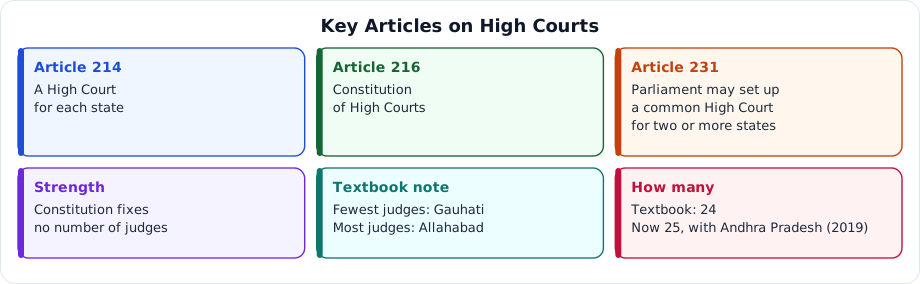
- Article 214: there shall be a High Court for each state. Article 216: constitution of High Courts.
- Article 231: Parliament may by law establish a common High Court for two or more states (or a state and a Union Territory).
- The Constitution fixes no number of judges, so strength differs; Gauhati had the fewest judges and Allahabad the most.
- There are 24 High Courts; with the Andhra Pradesh High Court (2019) there are now 25.
- Article 214.
- Article 231.
- Article 216: constitution of High Courts.
- Allahabad most, Gauhati fewest.
- 25 (the 24 predates the Andhra Pradesh HC of 2019).
- No number is fixed; the President decides as needed.
- Question: Which Article says there shall be a High Court for each state? Answer: Article 214.
- Question: Under which Article can Parliament set up a common High Court for two or more states? Answer: Article 231.
- Question: Article 216 deals with: Answer: Constitution of High Courts.
- Question: which High Court had the most judges? Answer: Allahabad.
- Question: How many High Courts are there in India now? Answer: 25.
- Question: Why is the number of judges different in different High Courts? Answer: The Constitution fixes no limit.
MCQs
Answer this question, then use Next.
Question 1: Which Article says there shall be a High Court for each state?
Question 2: Under which Article can Parliament set up a common High Court for two or more states?
Question 3: Article 216 deals with:
Question 4: which High Court had the most judges?
Question 5: How many High Courts are there in India now?
Question 6: Why is the number of judges different in different High Courts?
One-liners
Write your answer, then submit to see the correct answer.
Which Article says there shall be a High Court for each state?
Article 214.Under which Article can Parliament set up a common High Court for two or more states?
Article 231.Article 216 deals with:
Constitution of High Courts.which High Court had the most judges?
Allahabad.How many High Courts are there in India now?
25.Why is the number of judges different in different High Courts?
The Constitution fixes no limit.