Module 2: Part IX-A and Types of Municipalities
Concept
Subtopic 2.1: Part IX-A and Types of Municipalities
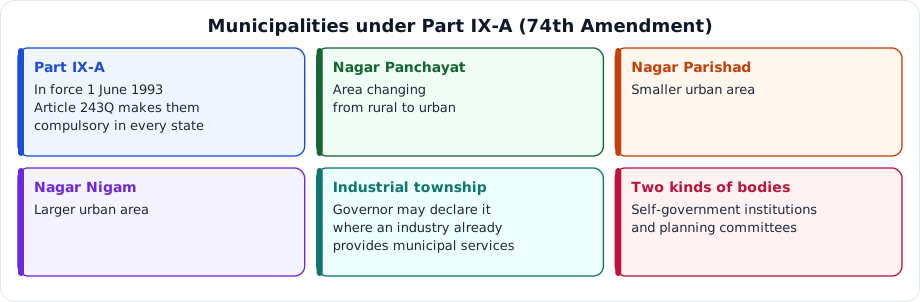
- Urban self-government got a constitutional basis through the 74th Amendment; Part IX-A came into force on 1 June 1993. It created two kinds of bodies: (i) self-government institutions and (ii) planning committees.
- Urban self-government bodies are called 'Nagarpalika'. Article 243Q (243थ) makes them compulsory in every state.
- Where an industrial establishment provides municipal services, the Governor may declare the area an industrial township; no municipality is needed there.
- Three types: (1) Nagar Panchayat - an area in transition from rural to urban; (2) Nagar Parishad - smaller urban area; (3) Nagar Nigam - larger urban area.
- 1 June 1993 (the 73rd Amendment took effect on 24 April 1993).
- Article 243Q.
- The 74th Amendment Act, 1992 (a misprint says '47th').
- A transitional area.
- The Governor.
- Self-government bodies and planning committees.
- Question: When did Part IX-A (municipalities) of the Constitution come into force? Answer: 1 June 1993.
- Question: Which Article makes it compulsory for every state to constitute municipalities? Answer: Article 243Q.
- Question: Which amendment gave constitutional status to municipalities? Answer: 74th.
- Question: A Nagar Panchayat is formed for: Answer: An area changing from rural to urban.
- Question: Who can declare an area served by an industrial establishment an 'industrial township'? Answer: Governor.
- Question: Part IX-A created which two kinds of bodies? Answer: Self-government institutions and planning committees.
MCQs
Answer this question, then use Next.
Question 1: When did Part IX-A (municipalities) of the Constitution come into force?
Question 2: Which Article makes it compulsory for every state to constitute municipalities?
Question 3: Which amendment gave constitutional status to municipalities?
Question 4: A Nagar Panchayat is formed for:
Question 5: Who can declare an area served by an industrial establishment an 'industrial township'?
Question 6: Part IX-A created which two kinds of bodies?
One-liners
Write your answer, then submit to see the correct answer.
When did Part IX-A (municipalities) of the Constitution come into force?
1 June 1993.Which Article makes it compulsory for every state to constitute municipalities?
Article 243Q.Which amendment gave constitutional status to municipalities?
74th.A Nagar Panchayat is formed for:
An area changing from rural to urban.Who can declare an area served by an industrial establishment an 'industrial township'?
Governor.Part IX-A created which two kinds of bodies?
Self-government institutions and planning committees.