Mod 1: Mineral Overview & Revenue
Geological Transition & Post-Bifurcation Scenario:
Prior to the state bifurcation in November 2000, undivided Bihar was one of the mineral-richest states in India, possessing vast deposits of iron ore, coal, bauxite, copper, and pyrite. Following the bifurcation, the mineral-rich southern plateau region was transferred to Jharkhand, leaving Bihar with predominantly agricultural plains. Nevertheless, the southern fringe adjoining the Chota Nagpur plateau remains geologically rich in non-metallic and minor minerals. The primary mineral-bearing districts in present-day Bihar include Kaimur, Rohtas, Aurangabad, Gaya, Nawada, Jamui, Munger, and Banka.
Strategic Mineral Profile (Pyrite Reserves):
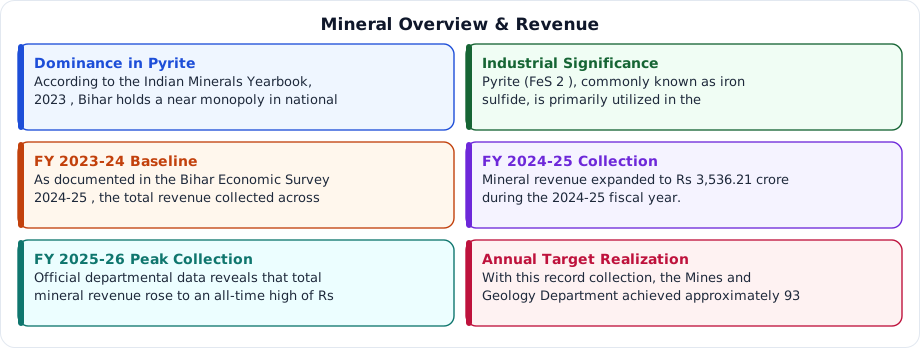
- Dominance in Pyrite: According to the Indian Minerals Yearbook, 2023, Bihar holds a near monopoly in national pyrite resources, accounting for approximately 94 percent of India's total pyrite reserves, while Rajasthan holds about 5 percent.
- Industrial Significance: Pyrite (FeS2), commonly known as iron sulfide, is primarily utilized in the manufacture of sulfuric acid and for agricultural soil conditioning (especially for neutralizing alkaline/sodic soils). The Vindhyan rock formations in the Amjhore region of Rohtas district host these major reserves.
Fiscal Trajectory & Revenue Collection Dynamics:
- FY 2023-24 Baseline: As documented in the Bihar Economic Survey 2024-25, the total revenue collected across all mineral sources in Bihar stood at Rs 3,114.79 crore.
- FY 2024-25 Collection: Mineral revenue expanded to Rs 3,536.21 crore during the 2024-25 fiscal year.
- FY 2025-26 Peak Collection: Official departmental data reveals that total mineral revenue rose to an all-time high of Rs 3,592.60 crore in FY 2025-26. This represents an absolute increase of Rs 56.39 crore over the revenue realized in FY 2024-25.
- Annual Target Realization: With this record collection, the Mines and Geology Department achieved approximately 93 percent of the annual benchmark target of Rs 3,850 crore fixed for FY 2025-26.
- Institutional & Technological Drivers: This sustained revenue growth has been accomplished through stringent regulatory and monitoring mechanisms, including the mandatory rollout of geo-fencing around active sand ghats and quarries, electronic transit passes (e-challans), integrated weighbridges, and aggressive statewide crackdowns on illegal mining and unauthorized transit.
- FY 2023-24 Baseline: As documented in the Bihar Economic Survey 2024-25, the total revenue collected across all mineral sources in Bihar stood at Rs 3,114.79 crore.
- FY 2024-25 Collection: Mineral revenue expanded to Rs 3,536.21 crore during the 2024-25 fiscal year.
- FY 2025-26 Peak Collection: Official departmental data reveals that total mineral revenue rose to an all-time high of Rs 3,592.60 crore in FY 2025-26. This represents an absolute increase of Rs 56.39 crore over the revenue realized in FY 2024-25.
- Annual Target Realization: With this record collection, the Mines and Geology Department achieved approximately 93 percent of the annual benchmark target of Rs 3,850 crore fixed for FY 2025-26.
- Institutional & Technological Drivers: This sustained revenue growth has been accomplished through stringent regulatory and monitoring mechanisms, including the mandatory rollout of geo-fencing around active sand ghats and quarries, electronic transit passes (e-challans), integrated weighbridges, and aggressive statewide crackdowns on illegal mining and unauthorized transit.
Answer this question, then use Next.
Question 1: According to the latest official data, what was the total revenue collected from all mineral sources in Bihar during FY 2025-26?
Question 2: According to the Indian Minerals Yearbook 2023, approximately what percentage of India's total Pyrite reserves is located in Bihar?
Question 3: What was the annual mineral revenue target set by the Mines and Geology Department for FY 2025-26, and what percentage of it was achieved?
Question 4: According to the Bihar Economic Survey 2024-25, what was the total revenue collected from all mineral sources in Bihar during FY 2023-24?
Question 5: By what amount did Bihar's mineral revenue collection in FY 2025-26 surpass that of FY 2024-25?
Question 6: Which other Indian state holds roughly 5 percent of the country's Pyrite reserves according to the Indian Minerals Yearbook 2023?
Question 7: Which district in Bihar is home to the famous Amjhore pyrite mining area?
Question 8: Which technological and administrative reform has been instrumental in checking illegal mining and boosting mineral revenue in Bihar?
Question 9: In present-day Bihar, which geographical belt predominantly contains the state's mineral wealth?
Question 10: What is the primary chemical composition and major industrial application of the mineral Pyrite (FeS2)?
One-liners
Write your answer, then submit to see the correct answer.
FY 2023-24 Baseline: As documented in the Bihar Economic Survey 2024-25, the total revenue collected across all mineral sources in Bihar stood at ______.
Rs 3,114.79 croreFY 2024-25 Collection: Mineral revenue expanded to ______ during the 2024-25 fiscal year.
Rs 3,536.21 croreFY 2025-26 Peak Collection: Official departmental data reveals that total mineral revenue rose to an all-time high of ______ in FY 2025-26. This represents an absolute increase of Rs 56.39 crore over the revenue realized in FY 2024-25.
Rs 3,592.60 croreAnnual Target Realization: With this record collection, the Mines and Geology Department achieved approximately ______ of the annual benchmark target of Rs 3,850 crore fixed for FY 2025-26.
93 percentInstitutional & Technological Drivers: This sustained revenue growth has been accomplished through stringent regulatory and monitoring mechanisms, including the mandatory rollout of ______ around active sand ghats and quarries, electronic transit passes (e-challans), integrated weighbridges, and aggressive statewide crackdowns on illegal mining and unauthorized transit.
geo-fencing