Module 2: National Education Policy (NEP) 2020 & Literacy Profile in Bihar
National Education Policy (NEP), 2020:
- Replaces the previous National Policy on Education framed in 1986.
- Expands the mandatory schooling age group from 6–14 years to 3–18 years (12 years of formal schooling with 3 years of Anganwadi / pre-schooling).
- Replaces the old 10+2 structure with the 5+3+3+4 curricular and pedagogical design:
- Foundational Stage (5 years): Age group 3–8 years (3 years of Anganwadi/pre-school + Grades 1 and 2 in primary school).
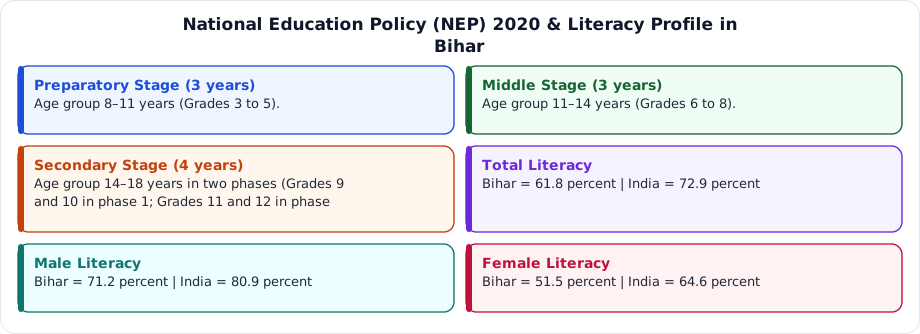
- Preparatory Stage (3 years): Age group 8–11 years (Grades 3 to 5).
- Middle Stage (3 years): Age group 11–14 years (Grades 6 to 8).
- Secondary Stage (4 years): Age group 14–18 years in two phases (Grades 9 and 10 in phase 1; Grades 11 and 12 in phase 2).
Figure 5.9.1: Literacy Rate in Bihar vs India (Census 2011):
- Total Literacy: Bihar = 61.8 percent | India = 72.9 percent
- Male Literacy: Bihar = 71.2 percent | India = 80.9 percent
- Female Literacy: Bihar = 51.5 percent | India = 64.6 percent
Bihar's overall literacy rate lags behind the national benchmark by 11.1 percentage points, with significant gender disparity.
- Replaces the previous National Policy on Education framed in 1986.
- Expands the mandatory schooling age group from 6–14 years to 3–18 years (12 years of formal schooling with 3 years of Anganwadi / pre-schooling).
- Replaces the old 10+2 structure with the 5+3+3+4 curricular and pedagogical design:
- Foundational Stage (5 years): Age group 3–8 years (3 years of Anganwadi/pre-school + Grades 1 and 2 in primary school).
- Preparatory Stage (3 years): Age group 8–11 years (Grades 3 to 5).
- Middle Stage (3 years): Age group 11–14 years (Grades 6 to 8).
- Secondary Stage (4 years): Age group 14–18 years in two phases (Grades 9 and 10 in phase 1; Grades 11 and 12 in phase 2).
- Replaces the previous National Policy on Education framed in ______ — 1986.
- Expands the mandatory schooling age group from ______–14 years to 3–18 years (12 years of formal schooling with 3 years of Anganwadi / pre-schooling). — 6
- Replaces the old 10+2 structure with the 5+3+3+4 curricular and pedagogical design:
- Foundational Stage (5 years): Age group 3–8 years (3 years of Anganwadi/pre-school + Grades 1 and 2 in primary school).
- Preparatory Stage (3 years): Age group 8–11 years (Grades 3 to 5).
- Middle Stage (3 years): Age group 11–14 years (Grades 6 to 8).
- Secondary Stage (4 years): Age group 14–18 years in two phases (Grades 9 and 10 in phase 1; Grades 11 and 12 in phase 2).
Answer this question, then use Next.
What was the female literacy rate in Bihar according to Census 2011?
One-liners
Write your answer, then submit to see the correct answer.
Replaces the previous National Policy on Education framed in ______
1986.Expands the mandatory schooling age group from ______–14 years to 3–18 years (12 years of formal schooling with 3 years of Anganwadi / pre-schooling).
6Replaces the old 10+2 structure with the 5+3+3+4 curricular and pedagogical design: Foundational Stage (5 years): Age group 3–8 years (3 years of Anganwadi/pre-school + Grades 1 and 2 in primary school).
Foundational Stage (5 years): Age group 3–8 years (3 years of Anganwadi/pre-school + Grades 1 and 2 in primary school).Preparatory Stage (3 years): ______
Age group 8–11 years (Grades 3 to 5).Middle Stage (3 years): ______
Age group 11–14 years (Grades 6 to 8).Secondary Stage (4 years): Age group 14–18 years in two phases (Grades 9 and 10 in phase 1; Grades 11 and 12 in phase 2).
Age group 14–18 years in two phases (Grades 9 and 10 in phase 1; Grades 11 and 12 in phase 2).