Mod 1: Agriculture and Allied Sectors
Strategic Importance Post-Bifurcation
* Economic Foundation: After the bifurcation of Bihar, the present state does not possess any substantial mineral resources or a sizeable industrial sector. The growth of the agriculture sector, therefore, assumes central importance for the overall growth of Bihar's economy. Agricultural development is fundamental to the state's economic progress.- Natural Resource Base: The base of agriculture in Bihar is its rich fertile soil combined with abundant water resources, particularly ground water.
- Cropping Diversity: Farmers in Bihar cultivate a wide variety of crops adapted to diverse soils across distinct agro-climatic zones.
* Other Major Crops: Pulses, oilseeds, fibre crops, sugarcane, fruits, and vegetables.
* Commercial Diversification: Growing market demand for flowers has shifted farmer interest toward floriculture.
- Socio-Economic Bridging: Achieving higher agricultural growth remains one of the most effective instruments to bridge rural-urban income disparities.
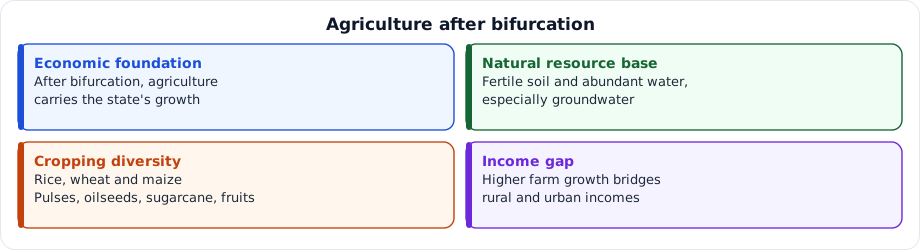
Figure: Agriculture after bifurcation
⭐ Key Points
- Natural Resource Base: The base of agriculture in Bihar is its rich fertile soil combined with abundant water resources, particularly ground water.
- Cropping Diversity: Farmers in Bihar cultivate a wide variety of crops adapted to diverse soils across distinct agro-climatic zones.
📌 One-line Q&A
- Natural Resource Base: The base of agriculture in Bihar is its rich fertile soil combined with abundant water resources, particularly ground water.
- Cropping Diversity: Farmers in Bihar cultivate a wide variety of crops adapted to diverse soils across distinct agro-climatic zones.
Answer this question, then use Next.
Question 1: Who described agriculture as the 'Core Competence of Bihar'?
Correct Option: (B) Dr. APJ Abdul Kalam
Question 2: Why did agriculture become the central driver of Bihar's economy after bifurcation?
Correct Option: (A) The state lacks substantial mineral reserves and large industrial base
Question 3: Which are the three major cereal crops grown in Bihar?
Correct Option: (A) Rice, wheat, and maize
Question 4: Bihar is widely regarded as a focal destination for which national agricultural mission?
Correct Option: (B) Second Green Revolution
Question 1 of 4
One-liners
Write your answer, then submit to see the correct answer.
Natural Resource Base: The base of agriculture in Bihar is its rich fertile soil combined with abundant water resources, particularly ground water.
The base of agriculture in Bihar is its rich fertile soil combined with abundant water resources, particularly ground water.Cropping Diversity: Farmers in Bihar cultivate a wide variety of crops adapted to diverse soils across distinct agro-climatic zones.
Farmers in Bihar cultivate a wide variety of crops adapted to diverse soils across distinct agro-climatic zones.